From Beauty Therapy Student to Future Salon Owner: Grace Wren’s Story
Choosing to study beauty therapy can feel like a big step, especially when it means changing direction, leaving a familiar job or committing to a new professional path. For Grace Wren, that decision came from a genuine interest in treatments, a desire to learn properly and a long-term ambition to build a career in the beauty industry.
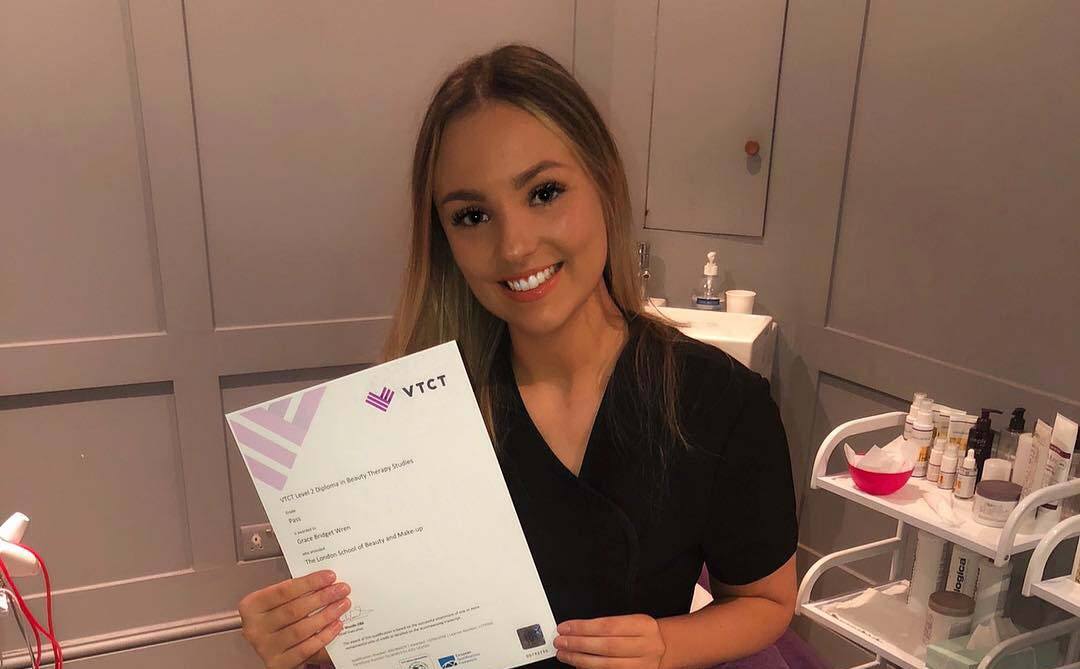
Grace studied the VTCT Level 2 Beauty Therapy Diploma at London School of Beauty before progressing to the VTCT Level 3 Beauty Therapy Diploma. She also planned to continue her training with the VTCT Level 4 Certificate in LASER & IPL Treatments, showing how a student can move from foundational beauty therapy into more advanced treatment areas over time.
Her interview is a helpful reminder that beauty therapy training is not only about learning treatment routines. It is also about gaining confidence, understanding client care and discovering which areas of the industry feel most rewarding in practice.
Starting beauty therapy training
Grace began studying with London School of Beauty in May 2018. At the time of the original interview, she was progressing through her beauty therapy training while also gaining practical salon experience.
When asked what she was studying, Grace explained:
“I did the Level 2 Beauty Therapy Diploma full time, and now I’m doing Level 3 Beauty Therapy Diploma with Spa Treatments part time and I work here in the salon two days a week as well. I’ll also be studying Level 4 Laser and IPL Treatments here too.”
For students planning a similar route today, the closest current beauty therapy options include the VTCT Level 2 Beauty Therapy Diploma, the VTCT Level 3 Beauty Therapy Diploma and the Level 2 and 3 Combined Beauty Therapy Diploma.
Grace’s pathway also connects naturally with the VTCT Level 4 Certificate in LASER & IPL Treatments for learners who meet the relevant entry requirements and want to progress into advanced aesthetic treatments.
Why Grace chose London School of Beauty
Grace’s decision was shaped by the feeling she had when she visited the school and by the opportunity to gain experience alongside her training.
“I came to look round here with my mum and I really liked the feel I got from it. The fact the school has a commercial salon is really good and it gives you such good experience. For most jobs you need experience, but it’s so hard to actually get the experience when you’re starting out, but with LSB courses you get that salon time so that’s a huge plus for me.”
What stands out in Grace’s answer is the importance of practical experience. Many students worry about how they will move from training into real client-facing work, particularly when job adverts often ask for experience. A course that helps students practise, build confidence and understand the expectations of a professional setting can make that transition feel more achievable.
Why she chose beauty therapy
Grace initially had interests in both beauty therapy and make-up, but after learning more about the treatments available within beauty therapy, she felt it was the right route for her.
“I wasn’t sure at first whether to do beauty therapy or make-up because I had an interest in both, but after looking around and hearing about all the treatments I thought beauty therapy was what I wanted to do. I also had in my mind I’d love to open my own salon so I thought I should learn all the treatments. I have a real interest in it, I love doing my eyelashes and having a spray tan and all sorts so I thought why not just learn it!”
This part of Grace’s story is especially useful for students who are still deciding which direction to take. Beauty therapy can appeal to people who enjoy variety and want to understand a broad range of treatments. It can also create a stronger foundation for learners who may later want to work in a spa, salon or clinic environment, or eventually open a business of their own.
London School of Beauty no longer offers make-up training as part of its current course list, so students considering their options today should focus on the school’s present beauty therapy, facials and aesthetics routes.
The best part of the course
For Grace, the most valuable part of training was the chance to put her learning into practice with real clients.
“The salon experience – 100%. Doing the treatments in class is great and you learn everything you need but when you get to work on real paying customers that’s what the real world is all about.”
Her answer captures an important part of professional beauty training. Classroom practice allows students to learn technique, sequence, consultation and safety under guidance. Working with clients then adds another layer of experience, because each person brings different expectations, questions and needs.
That is where students begin to understand the rhythm of professional practice. They learn how to communicate clearly, prepare properly, manage time and deliver a treatment while helping the client feel comfortable throughout the appointment.
Grace’s favourite treatments
When asked which treatments she most enjoyed providing, Grace chose facials.
“Facials for sure! It’s really relaxing for the client and it’s just one of those feel good treatments. You can also see the results straight away, you come out and your skin is glowing. With some treatments you have to do a course to start to see results but with facials it’s straight away.”
Grace’s answer shows the appeal of facial treatments for many students and clients. Facials combine hands-on technique, skin knowledge, relaxation and visible results, which can make them particularly rewarding to perform.
Grace’s advice for future students
Grace’s advice is simple and encouraging: if someone has a real interest in the industry, they should give themselves the chance to try.
“If you love something and you’ve got an interest in it, you should just do it. You don’t know if you’re going to enjoy it until you try. When I quit my full time job to come here, that was a massive step and I didn’t know if I was going to like it but if you have to just go for it and try it. And now I love coming here – I really enjoy it!”
Changing direction can feel daunting, particularly when it involves leaving full-time work or investing in training. Grace’s experience speaks to students who may be nervous about making that move. Interest alone does not remove the uncertainty, but it can be the reason someone takes the first step and explores whether the industry is right for them.
Her advice also reflects the importance of choosing a route that feels realistic. Some students may want to study full time, while others need a part-time option that fits around work or other commitments. Before enrolling, it is worth checking the course structure, attendance pattern and progression options so the training route supports the student’s wider life as well as their career aims.
What Grace learnt from training
One of the most valuable lessons Grace took from her experience was that confidence grows through practice. Treatments may not feel easy immediately, but repetition and support can help students improve.
“Even if sometimes things go wrong and don’t go the way you want them to go, you can always try again. If you need extra help there is always someone there to help you and you should never be afraid of things. I used to be terrified of waxing, but now I’m doing it more and more I don’t mind it as much! You just need to keep at it.”
This is an honest and reassuring point for anyone starting beauty therapy. It is normal for some treatments to feel more challenging at first. Waxing, massage, facials, manicure, pedicure, consultation and other practical skills all require time, guidance and repeated practice.
The key is not to expect perfection immediately. A good training environment should allow students to ask questions, receive feedback and keep developing their technique until they feel more confident. Grace’s comment shows how a treatment that once felt intimidating can become more manageable with support and experience.
Grace’s future career goal
Grace’s long-term goal was to gain professional experience and eventually open her own salon.
“I think I’d like to work in a spa and then my end goal would be to own my own salon!”
This is a route many beauty therapy students can relate to. Working in a spa or salon can help a newly qualified therapist develop confidence, understand different client needs and learn how a professional beauty business operates day to day. For those who later want to open their own salon, that experience can be extremely valuable.
Owning a salon requires more than treatment skill alone. It also involves client care, team management, service standards, communication, organisation and business awareness. Grace’s pathway from Level 2 Beauty Therapy into Level 3 and then towards Level 4 Laser and IPL shows how training can support gradual progression rather than being a single step.
Planning a beauty therapy route today
Grace’s story remains helpful because it shows how a student can begin with a broad beauty therapy qualification and then continue building towards more advanced or specialist areas. For learners who want to start with beauty therapy, current routes at London School of Beauty include the CIBTAC Beauty Therapy Diploma, VTCT Level 2 Beauty Therapy Diploma, Level 2 and 3 Combined Beauty Therapy Diploma and VTCT Level 3 Beauty Therapy Diploma.
For students more interested in facials and skin, the current options include Level 2 Facial Massage and Skincare, Level 2 and 3 Combined Facials and Skin Care Course + Level 3 Award in Anatomy and Physiology, and VTCT Level 3 Award in Facial Electrotherapy + Level 3 Award in Anatomical and Physiological Knowledge of Body Systems.
For learners ready to progress into advanced aesthetics, current options include VTCT Level 4 Certificate in LASER & IPL Treatments, ITEC (VTCT) Level 4 Combined Chemical Peel & Microneedling, VTCT Level 4 Microneedling Course and VTCT Level 4 Chemical Skin Peeling.
The most suitable route depends on a student’s starting point, existing qualifications and longer-term ambitions. Someone who wants a broad salon or spa foundation may choose a beauty therapy diploma, while someone drawn to facials and skin may prefer a more focused facial pathway. A student planning to progress into Laser and IPL or other Level 4 treatments should check the relevant entry requirements before applying.
Grace’s reflections bring the decision back to something very human. She was interested in beauty, willing to take a step into the unknown and open to learning through practice. That combination of curiosity, courage and consistency is often what helps students move from their first course into real professional confidence.
If Grace’s story has encouraged you to explore training, view the current London School of Beauty course list.