How to Become a Cosmetologist/Beauty therapist
Shine a Light on a Career in Cosmetology
If you are considering a career in cosmetology or beauty therapy, you may be wondering where to begin and what qualifications you need. You may already have an interest in skincare, facials, waxing, massage or beauty treatments, but feel unsure about how to turn that interest into a professional career.
In the UK, the term most commonly used for this career is beauty therapist, although the word cosmetologist is widely used internationally. When people search for “how to become a cosmetologist”, they are often looking for information about how to become a beauty therapist, skincare specialist or aesthetician.
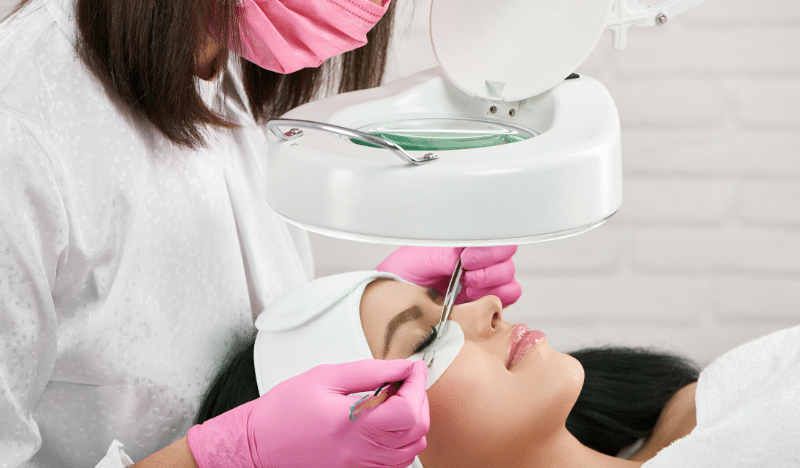
A cosmetologist or beauty therapist provides personal care services such as facials, skincare treatments, massage, manicures, pedicures, lash and brow treatments and waxing. They are responsible for evaluating a client’s skin and treatment needs, carrying out appropriate treatments and providing aftercare advice to help clients look after their skin and wellbeing at home.
The beauty and aesthetics sector includes a range of different roles. These may include beauty therapists, skincare specialists, facialists and aestheticians, with each area requiring its own knowledge, practical skills and professional training.
At London School of Beauty, students can become well-rounded in the essential areas of beauty therapy through structured training that combines theory with practical experience. If you are looking for a career where you can make the most of your beauty-related talents while working closely with clients, studying a beauty therapy course may be a suitable starting point.
Our courses begin with the basic skills and knowledge needed to enter the beauty industry, while also providing progression routes for beauty therapists who want to develop further through advanced facial, skincare and aesthetics training.
What Is a Beauty Therapist?
The occupation of a beauty therapist consists of providing a range of beauty treatments to clients. Depending on their qualifications, experience and the type of work they choose to pursue, a beauty therapist may work within a beauty business, spa, skincare clinic, aesthetics setting or on a freelance basis as a mobile therapist.
On a day-to-day basis, a beauty therapist may be responsible for carrying out treatments such as:
-
Facials and skincare treatments
-
Facial massage
-
Manicures and pedicures
-
Waxing and hair removal
-
Eyelash and eyebrow treatments
-
Body massage
-
Facial or body electrotherapy, depending on their level of training
However, the role involves much more than performing treatments. A professional beauty therapist must also be able to carry out a thorough client consultation, identify relevant contraindications, prepare the treatment area, maintain good hygiene standards and provide suitable aftercare advice.
Before beginning a treatment, you may need to discuss a client’s expectations, skin concerns, medical history and current skincare routine. You may also need to explain the treatment process, answer questions, carry out a patch test where appropriate and make sure the treatment is suitable for that individual.
This is why it is important to choose training that covers both practical treatment skills and the theory behind them. A beauty therapist needs to understand not only how to carry out a treatment, but also why a treatment may be suitable for one client and unsuitable for another.
Our Beauty Therapy and Aesthetics Courses
Our beauty therapy and aesthetics training includes courses and qualifications awarded by recognised awarding organisations, including VTCT and ITEC (VTCT), where stated.
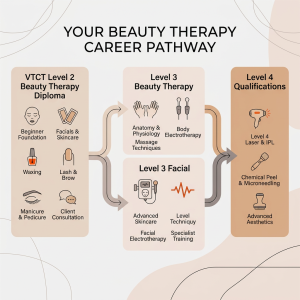
The courses are designed to support students at different stages of their development. Some learners begin with a broad Level 2 beauty therapy qualification, while others choose a more focused facial and skincare route. Qualified therapists can then progress towards Level 3 or Level 4 study in specialist areas.
The right course for you will depend on your existing experience, the treatments you would like to learn and the direction you would like your career to take.
VTCT Level 2 Beauty Therapy Diploma Course
For those who are complete beginners to the beauty therapy world, the VTCT Level 2 Beauty Therapy Diploma provides a broad foundation in the knowledge and practical skills needed to begin developing as a beauty therapist.
The Level 2 qualification introduces students to essential treatments across facials and skincare, waxing, lash and brow treatments, manicures and pedicures. It also helps learners understand consultation, contraindications, client care and professional conduct.
The course can help prepare students for entry-level roles within the beauty industry, depending on the requirements of the employer and the learner’s wider experience. It can also provide a foundation for progression to Level 3 beauty therapy or more specialist facial and aesthetics training.
Below is an overview of the areas covered throughout the course.
Facials and skincare
Students learn about the principles of facial and skincare treatments, including skin analysis, cleansing, balancing, toning and moisturising.
The practical element includes steaming, extraction and full facial massage. Students also learn about selecting, mixing and applying tailor-made face masques according to the client’s skin and treatment requirements.
The theory for this area includes the anatomy and physiology of the upper torso, including the muscles, bones, blood supply and nerve supply. Students also study the theory of the skin so that they can develop a better understanding of how skincare treatments are planned and adapted.
Waxing
Waxing is another important part of Level 2 beauty therapy training. Students learn about different methods of hair removal, including hot wax and cream strip wax.
The course covers techniques for waxing suitable areas of the face and body, as well as theory work relating to hair growth and hair growth patterns. Students also learn about post-treatment care techniques and the importance of providing clients with clear aftercare advice.
Waxing is a practical skill that requires precision, confidence and good communication. Students need to understand how to prepare the client, apply and remove the wax correctly and respond professionally throughout the treatment.
Consultation and selling skills
Consultation skills are an important part of becoming a professional beauty therapist. Students learn how to communicate with clients, identify their needs and understand the importance of gathering appropriate information before beginning a treatment.
Selling and recommendation skills are also included within the course. These skills should be approached professionally, with the focus on recommending suitable treatments and products according to the client’s needs rather than applying pressure.
A good consultation helps create trust between the therapist and client. It also allows the therapist to explain the treatment, manage expectations and provide appropriate advice.
Lash and brow treatments
The lash and brow section includes patch test techniques, eyelash and eyebrow tinting, eyelash perming or lifting techniques and eyebrow shaping.
These treatments require attention to detail and careful preparation. Students learn the importance of working safely around the eye area and ensuring that clients understand the treatment before it begins.
Patch testing is also an important part of suitable treatment preparation where required. Students develop an understanding of why patch tests are carried out and why treatments may need to be postponed if a client has not completed the appropriate requirements.
Manicure and pedicure
Manicure and pedicure training covers the maintenance and care of the nails and the skin of the hands and feet.
Students learn about the application of colour to the nails on both hands and feet, as well as French manicure and pedicure techniques. Paraffin wax and warm oil treatments are also included.
The theory for this unit includes an in-depth study of the structure of the nail, together with the relevant anatomy and physiology of the lower leg and forearms.
Although manicure and pedicure treatments form part of a wider beauty therapy qualification, they are not separate standalone nail technician courses. They are included as part of the broader Level 2 Beauty Therapy Diploma, which is designed to give students a rounded foundation in beauty treatments.
General competencies
The course also covers general competencies that support students in their development as professional beauty therapists. These include:
-
Contraindications to treatments
-
Client consultation
-
Selling and recommendation techniques
-
Treatment preparation
-
Professional communication
-
Client care and aftercare
-
Hygiene and professional standards
-
Reception and administrative skills
These areas are important because a beauty therapist’s role involves more than the treatment itself. The way you welcome a client, communicate with them, prepare the treatment and explain aftercare all contribute to the overall experience.
Building Confidence Through Practical Training
Practical experience is one of the most important parts of becoming a beauty therapist. Although theory provides the knowledge behind a treatment, confidence comes from practising the techniques repeatedly and receiving guidance from experienced tutors.
At London School of Beauty, students have extensive opportunities to practise the treatments they are learning. Practical work is built into the course so that students can develop their technique, improve their confidence and become familiar with the professional standards expected within the industry.
Students may practise:
-
Preparing the treatment area
-
Carrying out a client consultation
-
Selecting appropriate products
-
Performing facial and skincare treatments
-
Applying and removing wax
-
Carrying out lash and brow treatments
-
Performing manicure and pedicure procedures
-
Providing aftercare advice
-
Maintaining hygiene and professional organisation
This practical experience allows learners to become more comfortable with the full treatment process. It is one thing to understand a treatment sequence in theory, but it is another to work through the process carefully while considering client comfort, communication, product selection and treatment suitability.
Repeated practice also helps students develop muscle memory and greater consistency. Facial massage movements become more natural, waxing techniques become more precise and consultation conversations become easier to manage.
Students are also able to learn from tutor feedback. Tutors can observe practical work and provide guidance on areas such as hand position, pressure, treatment preparation, product application, client communication and professional conduct.
This feedback is valuable because it helps students correct small issues before they become habits. It also gives learners an opportunity to ask questions and understand how theory applies to different treatment situations.
Every client is different. One client may require a different pressure during a facial massage, while another may have specific skin concerns that need to be considered before a product or technique is selected. Practical training helps students develop the ability to adapt appropriately while maintaining professional standards.
The aim is not simply to complete a practical assessment. It is to develop the knowledge, judgement and confidence needed to work responsibly with clients.
Progressing Beyond Level 2
After completing the VTCT Level 2 Beauty Therapy Diploma, or if you are already a beauty therapist looking to progress further in your career, you may choose to continue your training at a higher level.
At London School of Beauty, progression options include:
-
VTCT Level 3 Award in Facial Electrotherapy + Level 3 Award in Anatomical and Physiological Knowledge of Body Systems
-
ITEC (VTCT) Level 4 Combined Chemical Peel and Microneedling
The most suitable route will depend on your experience and career goals. Some learners want to continue with broad beauty therapy training, while others are particularly interested in facial treatments, skin health or advanced aesthetics.
VTCT Level 3 Beauty Therapy Diploma
The VTCT Level 3 Beauty Therapy Diploma allows students to build on their Level 2 foundation and develop further knowledge and treatment skills.
Mandatory areas of the course include:
-
Anatomy and physiology
-
Massage
-
Facial electrotherapy
-
Body electrotherapy
-
Practical treatment work
-
Professional client care
Anatomy and physiology is an important part of progressing within beauty therapy. As treatments become more advanced, practitioners need a deeper understanding of the body and the structures relevant to the treatments they provide.
Facial and body electrotherapy also require careful practical training. Students need to understand the purpose of the equipment, how to prepare the client, how to apply the treatment correctly and when the treatment may not be suitable.
The practical element helps students become more comfortable with treatment procedures, equipment and client communication. It also allows tutors to provide feedback and help learners develop a more assured professional approach.
Level 2 and 3 Combined Beauty Therapy Diploma
For students who want to study both levels of beauty therapy training through one structured pathway, the Level 2 and 3 Combined Beauty Therapy Diploma provides an alternative route.
This programme brings together the foundational treatments covered at Level 2 with the more advanced knowledge and skills developed at Level 3. It may suit learners who want to build a broad treatment portfolio and progress through their training in a more streamlined way.
As with all professional beauty training, practical experience is an important part of the learning process. Students need time to practise the treatments, understand the theory and develop confidence in working with clients.
A Focused Route into Facial and Skincare Treatments
If your main interest is skincare and facial treatments, you may prefer to begin with the Level 2 Facial Massage and Skincare course.
This course provides a focused introduction to facial treatments, skin analysis, skincare knowledge and facial massage. It can be suitable for learners who want to develop their understanding of the skin and work towards a more specialist facial or skincare pathway.
Students learn why it is important to consider a client’s skin type, skin concerns and treatment goals when planning a facial. They also develop practical skills through repeated treatment practice and tutor guidance.
From there, learners may progress to the VTCT Level 3 Award in Facial Electrotherapy, together with the Level 3 Award in Anatomical and Physiological Knowledge of Body Systems.
This pathway allows students to develop more specialist knowledge of facial electrotherapy and the body systems relevant to professional treatment practice. Facial electrotherapy treatments use electrical currents or equipment within appropriate facial procedures, and students need to understand their purpose, application and relevant safety considerations.
Where Can I Study Beauty Therapy?
You can study beauty therapy at London School of Beauty, located at 2 Omega Place, London N1 9DR, near King’s Cross and St Pancras stations.
The school provides a structured training environment where students can develop both theoretical knowledge and practical treatment skills. Rather than relying only on classroom theory, learners have the opportunity to practise their treatments regularly and receive guidance from experienced tutors.
Practical training helps students become more familiar with the expectations of working with clients. It allows them to develop confidence in consultation, treatment preparation, hygiene, communication and aftercare.
Our tutors support students throughout their training and help them improve through demonstration, observation and feedback. This is particularly important for students who may feel nervous at the beginning of their course or who are returning to education after a period away from studying.
The transition from learning theory to performing a treatment can take time. With appropriate practice and support, students can gradually become more comfortable and assured in their approach.
What Our Former Students Say
We are proud to provide a supportive and practical education for our students. Below are some comments from former learners about their experience at London School of Beauty.
Twinkle Ladwa said:
“I completed my Level 2 in April and recently started my Level 3. I have really enjoyed my time in school, everyone is so helpful. I am so glad I have Alison and Jane as my mentor because they have always pushed me to do better even when things got too much for me to handle. Thank you!”
Sarah Vandersteen said:
“I recently completed the VTCT Level 2 Beauty Therapy course at London School of Beauty and am already eagerly waiting to return in September for the Level 3 course.
“My tutors, Alison and Jane, are professional, knowledgeable, friendly and patient. They invest so much of their time in preparing the theory and practical aspects of the course and do an amazing job at teaching a huge amount of information over an intense course.
“Alison and Jane teach with the highest standards and expectations in mind and ensure that only quality treatments take place in the classroom. Not only have they shaped me as a beauty therapist through their role as tutors, they have shared an abundance of advice, support and industry experience to help me to acquire a job a week out of training with a leading spa company.
“Lauren in the office is also super friendly and supportive, getting to know each student on a first-name basis and always happy to help. The ladies on the ground make this school an absolute success and I would recommend it to anyone, even if just for the pleasure of being taught by such superb women.”
Kates Edwards said:
“I completed the full Level 2 Beauty Therapy taught by Alison and Jane, who are the most incredible, patient and wise women and mentors. I absolutely loved my time there and have already signed up to Level 3 to continue my studies there.
“Such a welcoming environment, and there are always people there to help and answer any questions you have, especially Lauren in the office. She’s an angel. Looking forward to going back in September!”
Start Your Beauty Therapy Career
If you are researching how to become a cosmetologist or how to become a beauty therapist in the UK, a recognised beauty therapy course can provide the foundation you need to begin developing your career.
At London School of Beauty, students can start with the essential skills covered by the Level 2 Beauty Therapy Diploma, progress to Level 3 beauty therapy or follow a more focused route into facial and skincare treatments. Further progression is available through facial electrotherapy, anatomy and physiology and Level 4 advanced aesthetics training.
The right course for you will depend on your current experience, your interests and the type of treatments you would like to provide in the future. If you are unsure where to begin, our admissions team can help you understand the different options and identify a suitable training route.
If you are ready to get started with your beauty therapy career, contact London School of Beauty on +44 (0)20 3966 8690 or email admission@beauty-school.co.uk. A member of our admissions team will be happy to answer your questions and provide further information about our courses.